
The ₹2,000 Payment That Can Quietly Become a ₹50,000 Problem
Your credit card bill arrives.
Total Outstanding: ₹42,850
Minimum Amount Due: ₹2,143
If cash is tight, the smaller number feels comforting.
You tell yourself:
“I’ll pay the minimum this month and clear the rest later.”
For millions of Indian credit card users, this seems practical. After all:
- You avoid late payment fees.
- Your card remains active.
- Your payment is technically considered “on time.”
But what many users do not fully realise is this:
The unpaid balance continues attracting interest — often at annualised rates between 30% and 48% per annum depending on the issuer, repayment behaviour, and card type.
What starts as temporary flexibility can slowly become:
- growing interest costs
- prolonged repayment cycles
- high credit utilisation
- financial stress
- difficulty qualifying for future loans
This does not mean paying the minimum due is always wrong.
In certain situations, it can work as a temporary financial cushion.
The real issue begins when minimum due becomes a repayment habit instead of a short-term emergency solution.
This guide explains:
- what minimum due really means
- how Indian banks calculate it
- why it becomes expensive over time
- how it affects your credit profile
- common myths and mistakes
- practical strategies to escape the cycle
What Is the Minimum Amount Due on a Credit Card?
The minimum amount due is the smallest payment you must make before the due date to keep your credit card account from becoming overdue.
Every credit card statement generally displays two important figures:
| Statement Component | Meaning |
| Total Outstanding Amount | Full amount owed |
| Minimum Amount Due | Minimum payment required |
The minimum due is not your actual bill.
It is only the minimum threshold required to maintain repayment continuity.
In India, many issuers calculate the minimum due as a percentage of the total outstanding balance — commonly around 5%, though the exact calculation differs across banks and NBFC issuers.
According to publicly available issuer terms and RBI-regulated credit card practices, the minimum amount due may include:
- percentage of outstanding balance
- finance charges
- EMI instalments
- GST on fees and interest
- over-limit amounts
- late fees
- previous unpaid dues
Example: Understanding Minimum Due
Suppose your statement shows:
| Component | Amount |
| Total Outstanding | ₹50,000 |
| Minimum Due | ₹2,500 |
If you pay only ₹2,500:
- your account may avoid immediate late payment penalties
- your remaining ₹47,500 balance continues
- interest applies according to issuer terms
Many users incorrectly assume:
“If I paid the minimum due, the rest becomes interest-free.”
That is not how revolving credit works.
Why Do Credit Card Companies Offer Minimum Due?
Minimum due exists for legitimate reasons.
Credit cards are revolving credit products, and issuers understand that users may occasionally face cash-flow pressure.
1. It Provides Temporary Flexibility
Unexpected situations happen:
- medical emergencies
- salary delays
- business cash-flow gaps
- travel expenses
- home repairs
Minimum due gives borrowers temporary repayment flexibility.
2. It Helps Avoid Immediate Delinquency
From a lender’s perspective, partial repayment is better than complete non-payment.
Minimum due allows issuers to maintain repayment continuity while reducing immediate default risk.
3. It Supports the Revolving Credit Model
Credit cards are designed differently from fixed loans.
Balances can roll forward month after month.
Minimum due is part of that revolving structure.
According to the RBI’s Master Direction – Credit Card and Debit Card – Issuance and Conduct Directions, 2022, issuers are required to clearly disclose repayment terms, interest rates, and finance charges to customers.
Transparency matters because credit card interest can become expensive very quickly when balances revolve continuously.
How Is Minimum Due Calculated in India?
Many users believe minimum due is always exactly 5%.
In reality, different issuers use different formulas.
A simplified industry-style formula may look like this:
Minimum Due = 5% of Outstanding Balance
- EMI Amounts
- Finance Charges
- Past Due Amounts
- Overlimit Amounts (if any)
Illustration
Suppose:
| Component | Amount |
| Outstanding Balance | ₹80,000 |
| 5% Component | ₹4,000 |
| EMI Due | ₹1,200 |
| Interest Charges | ₹900 |
| Previous Unpaid Charges | ₹500 |
Your minimum due may become:
₹6,600
This explains why minimum due sometimes appears much higher than expected.
The Short-Term Benefits of Paying Minimum Due
Minimum due is not inherently harmful.
In some situations, it may help users manage temporary financial stress.
Avoiding Late Payment Fees
Late payment charges on Indian credit cards can become expensive depending on issuer slabs.
Paying at least the minimum due helps avoid immediate late fee penalties.
Maintaining Account Continuity
A minimum payment generally prevents the account from immediately becoming overdue.
This can help users manage temporary cash-flow gaps.
Emergency Liquidity Support
Consider this example:
Priya runs a small online business in Delhi.
One month, she faces:
- Delayed client payments
- GST obligations
- Unexpected medical expenses
Her credit card outstanding reaches ₹65,000.
She cannot comfortably clear the full amount immediately.
In such a situation, minimum due may provide short-term breathing room.
The key issue is not temporary use.
The problem begins when minimum repayment becomes a recurring pattern.
The Hidden Cost of Paying Only the Minimum Due
This is where many users underestimate the financial impact.
Several Indian credit cards charge monthly finance charges that can translate into annualised rates of 30%–48% or more.
Compared to many other forms of borrowing, this is expensive debt.
Example: ₹30,000 Outstanding Balance
Assume:
| Component | Amount |
| Outstanding Balance | ₹30,000 |
| Annual Interest Rate | 42% |
| Monthly Rate | 3.5% |
| Minimum Due | 5% |
Month 1
| Item | Amount |
| Opening Balance | ₹30,000 |
| Interest | ₹1,050 |
| Minimum Payment | ₹1,500 |
| Principal Reduced | Approx. ₹450 |
Even though you paid ₹1,500:
Most of it went toward interest.
Only a small portion actually reduced the debt.
This is why many users feel:
“I keep paying every month, but the balance barely decreases.”
What Happens After You Pay Only the Minimum Due?
Many users focus only on avoiding late fees.
But several other things happen behind the scenes.
1. The Remaining Balance Carries Forward
Suppose:
| Component | Amount |
| Total Outstanding | ₹40,000 |
| Minimum Due Paid | ₹2,000 |
The remaining ₹38,000 does not disappear.
It carries forward into the next billing cycle.
2. Interest Continues Accumulating
Interest applies to unpaid balances according to issuer policies.
If balances remain unpaid for long periods, interest compounds significantly.
3. You May Lose the Interest-Free Period
This is one of the most misunderstood aspects of credit cards.
When users regularly pay the full statement amount, purchases may enjoy an interest-free grace period.
But once balances revolve, future purchases may start attracting interest immediately depending on issuer rules.
This surprises many borrowers.
4. Your Minimum Due Can Increase Over Time
As balances grow:
- interest increases
- minimum due increases
- repayment pressure rises
What initially seemed manageable can slowly become stressful.
Case Study: How ₹45,000 Became a Long-Term Debt Problem
Rohan, a 32-year-old sales executive in Bengaluru, used his credit card responsibly for years.
Then he faced:
- medical expenses
- vehicle repair costs
- delayed incentive payout
His outstanding balance reached ₹45,000.
He started paying minimum due.
First Three Months
Everything felt manageable.
- no late fees
- card still active
- monthly payments seemed affordable
He assumed he would clear it “soon.”
Months 4–8
Rohan continued using the card for:
- groceries
- travel bookings
- dining
- small online purchases
The balance kept growing.
Interest accumulated faster than expected.
After One Year
Rohan had already paid thousands in repayments.
But his debt had reduced very little.
Why?
Because much of the repayment went toward interest rather than principal reduction.
This is the classic revolving debt cycle many credit counsellors observe.
Minimum Due vs Full Payment vs EMI Conversion
Understanding repayment options is important.
| Factor | Minimum Due | Full Payment | EMI Conversion |
| Immediate Relief | High | Low | Moderate |
| Interest Cost | High | Lowest | Moderate |
| Debt Duration | Long | None | Fixed |
| Predictability | Low | High | High |
| Financial Efficiency | Weak | Strong | Depends |
Full Payment
Usually the healthiest long-term approach.
Benefits:
- avoids finance charges
- preserves interest-free period
- improves financial discipline
- supports healthier credit behaviour
Minimum Due
Useful for temporary emergencies.
But prolonged usage often becomes expensive.
EMI Conversion
Many Indian issuers allow balance conversion into EMIs.
Advantages:
- structured repayment
- predictable instalments
- potentially lower repayment stress
However, users should carefully review:
- processing fees
- foreclosure charges
- effective interest rate
- GST implications
EMI is not automatically cheaper.
Does Paying Minimum Due Affect Your Credit Score?
This is one of the most searched questions among Indian card users.
The answer is nuanced.
Payment History
Paying minimum due is generally better than missing payments completely.
It helps maintain repayment continuity.
Credit Utilisation Ratio
Credit utilisation is:
Used Credit ÷ Total Credit Limit
Example:
| Component | Amount |
| Credit Limit | ₹1,00,000 |
| Outstanding Balance | ₹85,000 |
| Utilisation Ratio | 85% |
High utilisation may indicate elevated borrowing dependence.
Financial experts commonly recommend maintaining lower utilisation ratios for healthier credit profiles.
Long-Term Behaviour Matters
Lenders evaluate patterns.
Questions lenders may consider:
- Is debt reducing?
- Are balances persistently high?
- Is the borrower dependent on revolving credit?
Repeated minimum-only repayment behaviour may create concern over time.
Common Myths About Minimum Due
Myth 1: Paying Minimum Due Means the Bill Is Cleared
False.
Only the minimum repayment requirement is satisfied.
Myth 2: Interest Stops After Minimum Payment
Incorrect.
Interest generally continues on unpaid balances.
Myth 3: Minimum Due Is Always Bad
Not necessarily.
Temporary emergency usage may be reasonable.
Habitual use is the real concern.
Myth 4: Small Credit Card Balances Cannot Become Serious Debt
High interest plus time can transform even moderate balances into large repayment burdens.
Common Mistakes Credit Card Users Make
Continuing Fresh Spending
Many users continue using the card while revolving debt.
This often worsens repayment pressure.
Ignoring Statement Details
Most users only check:
- due date
- minimum amount
But ignore:
- finance charges
- GST
- annualised interest
- transaction breakdown
Treating Credit Limit as Extra Income
A credit limit is borrowing capacity — not disposable income.
This distinction is critical.
Warning Signs You Are Falling Into a Debt Trap
Watch for these signs:
- paying minimum due for several months continuously
- balance barely reducing
- relying on one card to pay another
- using most of your available credit limit
- salary disappearing into repayments
- taking personal loans to manage card debt
These signals indicate repayment stress may be increasing.
How to Break the Minimum Due Cycle
1. Stop Fresh Spending Temporarily
This is often the most important first step.
Reducing new spending prevents balances from growing further.
2. Pay More Than the Minimum
Even modest additional payments can significantly reduce long-term interest costs.
Example:
Paying ₹5,000 instead of ₹2,000 monthly may dramatically shorten repayment time.
3. Consider EMI Conversion Carefully
Structured repayment may help users regain control over finances.
But compare total repayment cost before converting.
4. Build a Repayment Strategy
Two commonly discussed approaches:
Avalanche Method
Prioritise highest-interest debt first.
Snowball Method
Clear smallest balances first for psychological momentum.
5. Create an Emergency Fund
One reason users depend heavily on credit cards is lack of emergency savings.
Even a small emergency reserve improves financial resilience.
Expert Insights: What Financial Advisors Commonly Observe
Credit counsellors and repayment advisors frequently observe that:
- Minimum due itself is not the problem
- Repeated dependency creates the problem
- Behavioural patterns matter more than isolated incidents
Temporary flexibility is manageable.
Long-term revolving debt becomes expensive.
Research and Industry Context
India’s credit card market has expanded rapidly in recent years, with RBI data showing continued growth in card issuance and transaction volumes.
At the same time:
- Revolving credit usage has increased
- Digital spending has accelerated
- Unsecured borrowing exposure has risen
Most major issuers publicly disclose finance charges that can exceed 3% monthly in many cases.
When annualised, this may exceed 40% per annum.
This is why repayment discipline matters significantly in credit card usage.
Practical Tips for Responsible Credit Card Usage
- Pay full statement balance whenever possible
- Use minimum due only for temporary emergencies
- Track monthly spending actively
- Keep utilisation under control
- Avoid impulse spending on credit
- Read statement details carefully
- Understand your issuer’s finance charge structure
- Set payment reminders or auto-pay
Frequently Asked Questions (FAQs)
Is paying the minimum due bad for credit score?
Not immediately. Paying minimum due is usually better than missing payments entirely. However, consistently carrying high balances may negatively affect your credit profile over time.
Does paying minimum due stop interest?
No. Interest generally continues on unpaid balances according to issuer terms.
Can I continue using my credit card after paying minimum due?
Usually yes, provided the card remains active and within limit. However, continued spending while revolving debt may worsen repayment pressure.
What happens if I pay less than the minimum due?
You may face:
- late payment fees
- interest charges
- possible negative reporting if delinquency continues
- reduced creditworthiness
Is EMI better than paying minimum due?
In many situations, structured EMI repayment may offer better predictability than revolving high-interest balances. But users should compare total repayment costs carefully.
How long does it take to clear debt by paying minimum due only?
Potentially many years depending on balance size, interest rates, and spending behaviour.
This is why financial experts discourage long-term dependency on minimum repayments.
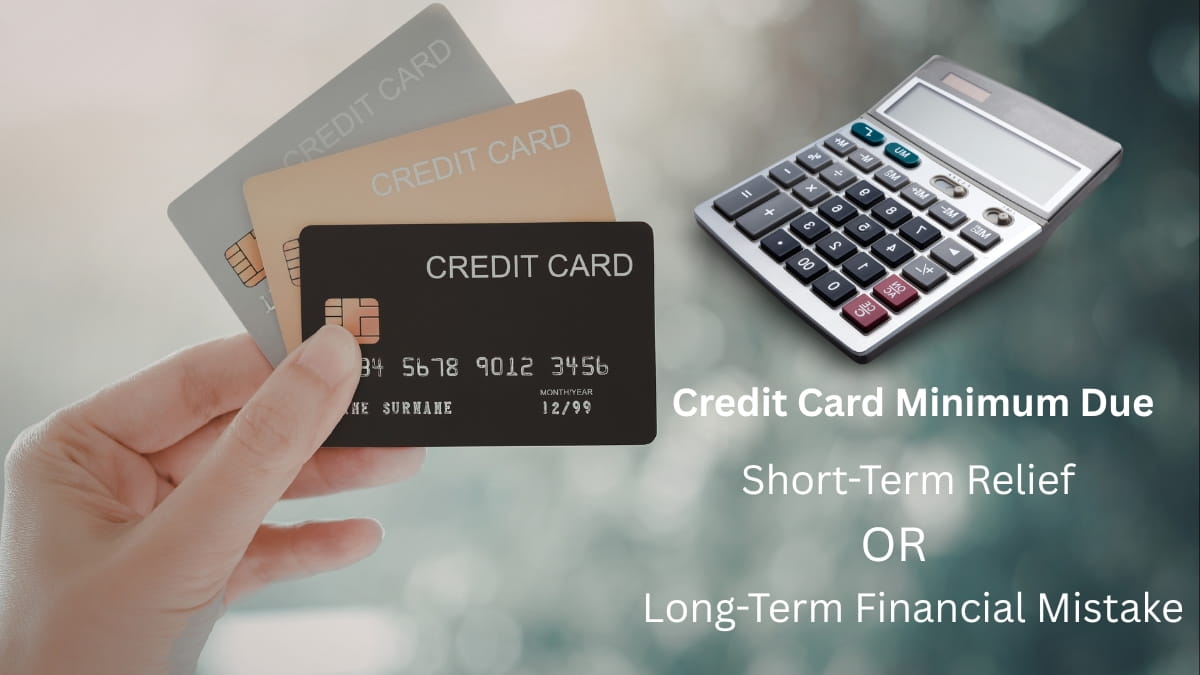
Final Verdict: Short-Term Relief or Long-Term Financial Mistake?
Credit card minimum due is not inherently dangerous.
In fact, during genuine emergencies, it can provide temporary financial breathing space.
But it is important to understand what minimum due actually represents:
It is not a repayment solution.
It is a temporary continuation mechanism for revolving debt.
When used occasionally and strategically, minimum due may help users manage short-term cash-flow disruptions.
When used repeatedly, it can become one of the costliest repayment habits in personal finance.
The smartest approach is simple:
- Pay the full statement balance whenever possible
- If full payment is difficult, pay substantially above the minimum
- Avoid continuous revolving debt
- Understand your interest costs clearly
- Treat credit cards as financial tools, not income substitutes
Used responsibly, credit cards offer convenience, rewards, and financial flexibility.
Used carelessly, they can quietly turn short-term convenience into long-term financial pressure.

I am an experienced advocate with 8 years of expertise in handling legal matters related to loan settlement services. I am skilled in providing effective legal solutions, negotiating settlements, and representing clients in complex financial disputes, ensuring their rights are protected throughout the process.